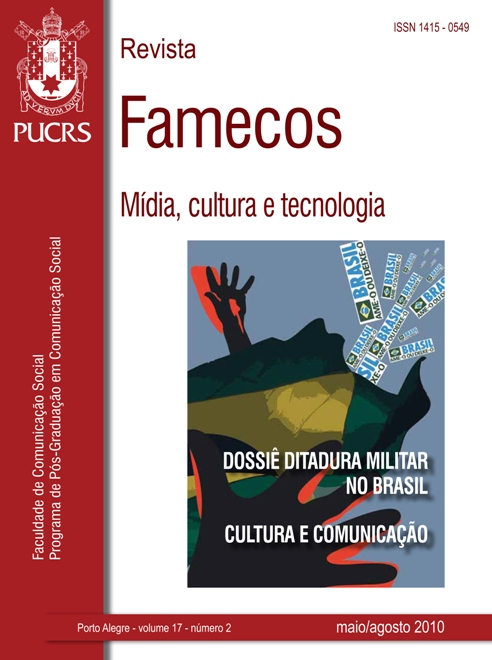
The Red Danger in Brazilian cinema: the narratives of political exiled people and ex-prisoners of the military dictatorship in the contemporary documentary
DOI:
https://doi.org/10.15448/1980-3729.2010.2.7543Keywords:
Documentary, memory, Military dictatorshipAbstract
In the first decade of 2000 the Brazilian cinema demonstrated a growing interest in portray in the screens episodes of the military dictatorship in the country, rummaging through hurts, complex and painful subject of our past. What for some military men was a revenge of the communists or of the Brazilian political left that would have invaded the Brazilian media. This way, starting from the analyzes of the Vlado, 30 years later (2005), Hércules 56 (2006) and Caparaó (2006) movies, we intended to point some initial reflections about how the contemporary Brazilian documentary, when update the past of the military dictatorship from a ethical and political compromise with the memory of the ones who participated of the armed fight in the country, struggle a esthetical fight against the forgetfulness and the denial of a dark period of the recent Brazilian history.Downloads
References
BENJAMIN, Walter. Obras escolhidas I. Magia e técnica, arte e política. v.1. São Paulo: Brasiliense, 1985.
D’aRAUJO, Maria Celina; SOARES, Gláucio Ary Dillon; CASTRO, Celso (Orgs.). Visões do golpe: a memória militar sobre 1964. Rio de Janeiro: Relume-Dumará, 1994.
GAGNEBIN, Jeanne Marie. Verdade e memória do passado. Projeto História, São Paulo, v.17, p. 213-221, 1998.
MARTINS FILHO, João Roberto. A guerra da memória: a ditadura militar nos depoimentos de militantes e militares. Varia História, Belo Horizonte, n. 28, p. 178-199, dez. 2002.
MOTTA, Rodrigo Patto Sá. Em guarda contra o perigo vermelho: o anticomunismo no Brasil (1917-1964). São Paulo:
Perspectiva, 2002.
NORA, Pierre. Entre memória e história: a problemática dos lugares. Projeto História, São Paulo, n.10, p. 7-29, dez. 1993.
RAMOS, Fernão. Teoria Contemporânea do Cinema: Documentário e Narratividade Ficcional. vol. 2. São Paulo: Senac, 2005.